Nuova pagina 1


|
Nuova pagina 1
|
|
|
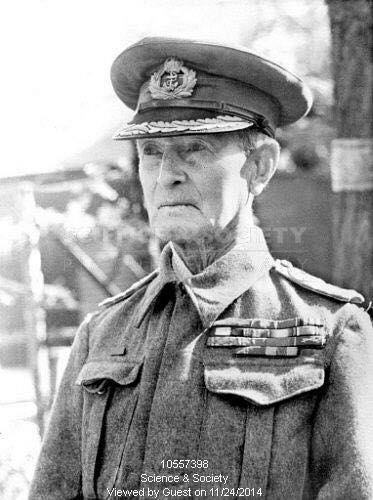
Admiral Sir Walter Henry Cowan, 1st Baronet, KCB, DSO & Bar, MVO (11 June 1871 – 14 February 1956), known as Tich Cowan, was a Royal Navy officer who saw service in both the First and Second World Wars; in the latter he was one of the oldest British servicemen on active duty.
During the Second World War, Cowan was given a job by his old friend Roger Keyes, then head of the Commandos. Cowan voluntarily took the lower rank of commander and went to Scotland in 1941 to train the newly formed corps in small boat handling.[1] He managed to get himself sent to the North African theatre of operations with the Commandos. Shortly after arrival he saw action at the second Battle of Mechili in April 1941. In May 1941, in his 72nd year, Cowan took part in two abortive seaborne raids with No. 8 (Guards) Commando involving an expedition along the North Egyptian and Cyrenaica coast aboard HMS Aphis, a river gun-boat from the China Station with a top speed of 12 knots. The expeditions were repeatedly attacked from the air over several days by Axis forces before being constrained to abandon the endeavour on the second attempt through battle damage to the boat's rudder mechanism, which limited it to going around in circles in repetition. During the incessant attacks, with scores of bombs splashing into the sea about the vessel, Cowan (believed by the commandos in whose midst he was, to be seeking a heroic death in action) was regularly to be seen on the deck blazing away at the oncoming hostile aircraft with a Tommy Gun.[5] Cowan also saw action subsequently at the Battle of Bir Hakeim, where, having attached himself to the Indian 18th King Edward VII's Own Cavalry, he was captured on 27 May 1942,[1] having fought an Italian tank crew single-handedly armed only with a revolver. He was repatriated in 1943 under an agreement with Italy whereby some 800 Italian seamen interned in neutral Saudi Arabia from the Red Sea Flotilla were exchanged for a similar number of British prisoners of war. An unusual feature was that there was no stipulation about the men's future activities and they were free to return to action. Accordingly, Cowan rejoined the commandos and saw action again in Italy during 1944. He was awarded a Bar to his Distinguished Service Order for "gallantry, determination and undaunted devotion to duty as Liaison Officer with Commandos in the attack and capture of Mount Ornito, Italy and during attacks on the islands of Solta, Mljet and Brac in the Adriatic, all of which operations were carried out under very heavy fire from the enemy".[6] Cowan retired once more in 1945. After the war he was invited to become the honorary colonel of the 18th King Edward's Own Cavalry, and visited India to receive the post, which he considered the greatest he had attained in his extensive military career.[7] Wikipedia Source
At the Battle of Bir Hakeim, where, after joining the 18th Regiment of King Edward VII's Indian Cavalry, he was captured on May 27, 1942, after fighting alone against an Italian tank crew armed only with a revolver. Well, what can I say? Too bad the story is slightly different. At least according to Italian sources. It was Admiral Sir Walter Cowan, who, out of a sense of adventure, had joined the 18th Cavalry as a naval liaison officer. According to one source, two tanks a short distance away called on him to surrender, to which the admiral replied, "Dog! I'm not surrendering!" and unloaded his pistol on both vehicles. Afterwards he was disarmed and taken away (W.G. HINGSTON and G.R. STEVENS, The Tiger Kills: the story of the Indian Divisions in the North African Campaign, H.M.S.O., London 1944). According to a more realistic version: "In reality the fighting was already over and the hot old man (he was seventy-two years old) was in a foxhole and stubbornly refused to surrender to Lieutenant Emiliano D'Anna, who with his unmistakable Roman accent kept urging him to surrender with good-natured: “Daje! Vié fora!” It was the personal intervention of Maj. Pinna that broke the deadlock with an imperious gesture of his arm accompanied by the snap of his middle finger and thumb. The Admiral, content to surrender to a superior officer, grabbed one of his briefcases, was loaded into an armored car, and taken to prison" (F. VIGLIONE, Tentativo di ricostruzione di un mattino di guerra del 132° Reggimento Carri "Ariete"op. citata, p. 91). Fonte MONTANARI MARIO Le Operazioni in Africa Settentrionale Vol. III El Alamein (gennaio-novembre 1942) Stato Maggiore dell'Esercito Ufficio Storico Roma Ediz. 2006 |